Thursday, December 16, 2010

Bee Informed, Part 6: The EPA and Neonicotinoids (The Dance Continues)

There has been a lot of talk lately in the news and, I can only assume, around the proverbial water cooler, about “leaked” government documents and their embarrassing political effects on the federal departments concerned. Many of these have made headlines, and some have not.

Well, a couple of days ago, the Pesticide Action Network of North America got their hands on an internal memo from the Environmental Protection Agency (you know, those folks whose job it is to protect the environment) which shows that the EPA has ignored and even intentionally suppressed the findings of its own scientists regarding neonicotinoid pesticides and their harmful effect on honeybees and other so-called “non-target” pollinators. (Non-target pollinators include bees, wasps and butterflies, which, although not the intended target of an insecticide, are affected by it nonetheless.)

You may recall a previous article of mine entitled Bee Informed, Part 3: The “Mystery” of Colony Collapse Disorder in which I make the case that neonics are largely responsible for CCD, and that countries that have banned the use of these systemic nicotine-based pesticides have seen a reverse in their honeybee population decline. To briefly summarize, this type of pesticide is a toxic chemical containing synthesized nicotine in liquid form that is sprayed on crop seeds (such as corn, canola, sugar beets, soy and wheat) and spreads throughout the vascular system to every part of the mature plant, including nectar and pollen, after the seed has germinated. In theory, this saves farmers the time, money and effort required to spray pesticides on their plants. The type most widely in use in the United States is Clothianidin, manufactured by Bayer Corp, sold under the trade name “Poncho.” It is classified by the EPA as a Category III toxic substance, and a “not likely” human carcinogen. The "Summary Science Statements" published in an EPA Pesticide Fact Sheet on Clothianidin from 2003, submitted to the EPA by Bayer as part of the registration process, state:

“Based upon a battery of acute toxicity studies, Poncho 600 is classified as Toxicity Category III. Clothianidin is classified as a “not likely” human carcinogen. There are no to low concerns and no residual uncertainties with regard to pre- and/or postnatal toxicity from clothianidin, and the FQPA 10X Safety Factor has been removed. However, due to evidence of effects on the rat immune system and that juvenile rats appear to be more susceptible to these effects, and due to the lack of a developmental immunotoxicity study, a 10X database uncertainty factor is applied to all dietary exposure endpoints.
Available data indicate that clothianidin on corn and canola should result in minimal acute toxic risk to birds. However, assessments show that exposure to treated seeds through ingestion may result in chronic toxic risk to non-endangered and endangered small birds (e.g., songbirds) and acute/chronic toxicity risk to non-endangered and endangered mammals. Clothianidin has the potential for toxic chronic exposure to honey bees, as well as other nontarget pollinators, through the translocation of clothianidin residues in nectar and pollen. Clothianidin should not present a direct acute or chronic risk to freshwater and estuarine/marine fish, or a risk to terrestrial or aquatic vascular and nonvascular plants.
The fate and disposition of clothianidin in the environment suggest a compound that is a systemic insecticide that is persistent and mobile, stable to hydrolysis, and has potential to leach to ground water, as well as runoff to surface waters.”

This was back in 2003, when Bayer first registered clothianidin for sale in the U.S., and neonicotinoid pesticides were still a fairly recent development (as was CCD). The damage to birds, rats and other mammals, and honeybees, was postulated but uncertain, and, in a transparently industry-friendly decision, it was still considered an acceptable risk - since it was considered unlikely to have chronic effects on humans. Plus, you know, there was money to be made. Of course, the EPA didn't run any tests themselves - they accepted the results of tests conducted by Bayer Corp's paid scientists. Later in this same report, this paragraph is found:

“Chemical-specific data for assessing human exposures during pesticide handling activities were not submitted to the Agency in support of the registration of clothianidin. Instead, the registrant (Bayer) submitted surrogate studies using the chemicals Oftanol (isofenphos) and Baytan (triadimenol). Bayer Corp. also submitted two exposure assessments which used these seed treatment exposure studies as surrogates for exposure to clothianidin.”

That was apparently good enough for the Environmental Protection Agency. Bayer, the very company that sought to profit from the sale of a toxic substance to be used on food crops, was allowed to perform its own testing to determine health risk to humans, with no oversight or even independent study to confirm or refute its results. Indeed, when strong concerns over mounting evidence of ecological damage done by neonicotinoids was voiced by its own experts, the EPA ignored them completely. Moreover, the EPA felt the company had sufficiently demonstrated the safety of its product by using the results of testing with a completely different chemical in place of the one they intended to sell. The Agency green-lighted its registration without a second thought; birds, bees and endangered mammals be damned. Our environmental watchdog would clearly prefer the life of a corporate lapdog.

Since 2003, scientists at the EPA have conducted some tests in response to the insistent nagging of reality, and what they found contrasted sharply with Bayer Corp's spurious and profit-driven reporting. The EPA scientists essentially rejected these findings, and reiterated their concern about the risk to the North American honeybee population of widespread use of clothianidin and other neonics.

Let's jump forward to the document in question, though, dated November 2, 2010. I won't bore you with the sordid history of the attempts to halt Bayer's sale of neonics since 2003, thwarted largely by the EPA, and justified by ridiculously unscientific field studies such as this one, published in 2007. (This study, written by the Department of Environmental Biology at the University of Guelph, in Ontario, Canada - and funded by Bayer - claims that colonies of honeybees showed no detrimental effects from long-term exposure to clothianidin. The failing of this study lies in the fact that the pesticide was only applied on 2.5 acre plots - a tiny sliver of bees' actual foraging range, as opposed to the enormous, unbroken swaths of farmland planted with neonics in the U.S. In his assessment of this particular study, Colorado beekeeper Tom Theobald aptly noted, “Imagine you're a rancher trying to figure out if a noxious weed is harming your cows. If you plant the weed on two acres and let your cows roam free over 50 acres of lush Montana grass, you're not going to learn much about that weed.”)

In response to Bayer's efforts to expand the use of neonics to mustard and cotton, this most recent memo was written by two scientists at the EPA's Environmental Fate and Effects Division (EFED), ecologist Joseph DeCant and chemist Michael Barrett, and expresses their serious concerns about clothianidin's lethal effects on honeybees. They wrote:

“Clothianidin’s major risk concern is to nontarget insects (that is, honey bees). Clothianidin is a neonicotinoid insecticide that is both persistent and systemic. Acute toxicity studies to honeybees show that clothianidin is highly toxic on both a contact and an oral basis. Although EFED does not conduct RQ based risk assessments on non-target insects, information from standard tests and field studies, as well as incident reports involving other neonicotinoids insecticides (e.g., imidacloprid) suggest the potential for long term toxic risk to honey bees and other beneficial insects. An incident in Germany already illustrated the toxicity of clothianidin to honeybees when allowed to drift off-site from treated seed during planting.
A previous field study (MRID 46907801/46907802) investigated the effects of clothianidin on whole hive parameters and was classified as acceptable. However, after another review of this field study in light of additional information, deficiencies were identified that render the study supplemental. It does not satisfy the guideline 850.3040, and another field study is needed to evaluate the effects of clothianidin on bees through contaminated pollen and nectar. Exposure through contaminated pollen and nectar and potential toxic effects therefore remain an uncertainty for pollinators.
EFED expects adverse effects to bees if clothianidin is allowed to drift from seed planting equipment. Because of this and the uncertainty surrounding the exposure and potential toxicity through contaminated pollen and nectar, EFED is recommending bee precautionary labeling.”

The deficient “previous field study” cited by DeCant and Barrett was, of course, that same Guelph report from 2007, funded by Bayer Corp and used to downplay the risks involved in order to justify the continued use and sale of neonics, specifically on corn. The authors of the memo go on to say:

“Honey Bee Toxicity of Residues on Foliage (850.3030): This study is required for chemicals that have outdoor terrestrial uses in which honeybees will be exposed and exhibit an LD50 <11μg>
Field Test for Pollinators (850.3040): The possibility of toxic exposure to nontarget pollinators through the translocation of clothianidin residues that result from seed treatments has prompted EFED to require field testing (850.3040) that can evaluate the possible chronic exposure to honey bee larvae and queen. In order to fully evaluate the possibility of this toxic effect, a field study should be conducted and the protocol submitted for review by the Agency prior to initiation. Another study had been submitted to satisfy this guideline requirement. While it had originally been classified as acceptable, after recent reevaluation it is classified as supplemental, and a field study is still being needed for a more refined risk assessment.”

Downgrading a study from “acceptable” to “supplemental,” however, doesn't alter the final status of neonicotinoids as safe to use on a huge scale, according to EPA rules. And in the very probable case that the previous statements were too obtuse for whomever the memo was intended, DeCant and Barrett summarize their opinion thusly, as their recommendation for language to be included on the chemical's label:

“This product is toxic to aquatic invertebrates. Do not apply directly to water or to areas where surface water is present or to intertidal areas below the mean high-water mark. Do not contaminate water when cleaning equipment or disposing of equipment washwaters. Do not apply where runoff is likely to occur. Runoff from treated areas may be hazardous to aquatic organisms in neighboring areas. Apply this product only as specified on the label.
This chemical has properties and characteristics associated with chemicals detected in ground water. The use of this chemical in areas where soils are permeable, particularly where the water table is shallow, may result in ground water contamination.
This compound is toxic to birds and mammals. Treated clothianidin seeds exposed on soil surface may be hazardous to birds and mammals. Cover or collect clothianidin seeds spilled during loading.
This compound is toxic to honey bees. The persistence of residues and potential residual toxicity of Clothianidin in nectar and pollen suggests the possibility of chronic toxic risk to honey bee larvae and the eventual instability of the hive.”

It couldn't be clearer than that. And all of the paragraphs that I have quoted are found in the introduction of the memo, before the report even begins. The following 100 pages of the complete document specify risk assessment and set the parameters for field studies that the authors have determined must be conducted in order to determine actual effects, during which time the sale and use of neonics must be suspended.

This is only the latest example of the EPA ignoring and burying the concerns of its own scientists who are in the honest business of trying to fulfill the mandate set out for them, i.e., environmental protection. Which brings us to the obvious question - why would the Environmental Protection Agency continue to allow the use of chemicals which cause such irreparable harm to the environment, favoring pseudo-scientific studies that support the claims of its manufacturer while suppressing reports written by its own scientists warning of environmental damage? Since 2003, corn has been the largest crop in the United States by a huge margin (88 million acres), and in 2009 alone, Bayer made about $262 million from its sale of Clothianidin, the insecticide used to treat corn seeds in the U.S. It doesn't take a great leap of the imagination to understand this relationship. And when asked if the revelation of this document might finally convince the EPA to remove Clothianidin from the market, at least until proper field studies to determine its impact can be conducted, an EPA spokesman authorized to speak on behalf of the Agency replied that the pesticide will retain its registration status and be available again for spring planting. So that's good news... for Bayer Corp.


Sources:

2010 EPA Memo:
DeCant and Barrett, Clothianidin Registration of Prosper T400 Seed Treatment on Mustard Seed (Oilseed and Condiment) and Poncho/Votivo Seed Treatment on Cotton

2007 Bayer-funded Guelph Report:
Cutler and Scott-DuPree, Exposure to Clothianidin Seed-Treated Canola Has No Long-Term Impact on Honey Bees

2003 EPA Clothianidin Pesticide Fact Sheet:
Clothianidin Conditional Registration

(Links to the document files to come.)

Monday, November 15, 2010

Pre-Winter Hive Inspection, or: "We'll Meet Again..."

November, 2010 - Winter is on its way, and thanks to some extra-long autumnal weather, we were able to take one more trip out to the hive to check on its progress and estimate the bees' chances of surviving winter before the real cold arrives.

We had a relatively mild summer here in eastern Kansas, and winter seems to be reluctant to show itself (so far), and there was still foraging activity even into early November, amazingly enough. Around mid-November, though, nighttime temperatures dropped below freezing, so that was the end of that. The bees have packed it in for the winter now, turning the page on my first season as a beekeeper. Now begins the waiting game.

As I noted in a recent post, a colony of honeybees, depending on its size, needs about 60 pounds of honey stored in the hive if they hope to survive during the cold months. Foraging is simply out of the question during the winter, since plants are no longer flowering, and even brief exposure to freezing temperatures is fatal to bees.

So the question is, do my bees have enough honey to feed them for the next three months (or more)? The short answer is that I don't know. However, I'm cautiously optimistic. The lower super is likely completely full, and the upper super is about half full. I estimate that the colony has stocked between 50 and 60 lbs. in the hive. Considering that these bees were installed in their home (which was completely empty) on June 1st, their numbers are probably fairly modest: I estimate about 30,000 bees in the colony at the present time, maybe less. If my novice guesswork is accurate, my girls should have enough to last throughout the winter, with even a possible surplus once spring arrives.

The inspection on November 8, my last until the spring, was a cursory one. Upon our arrival, it was obvious that the bees were no longer in foraging mode. The activity around the hive entrance can only be described as "subdued." It appears that without flowers to visit and inventory to stock, the colony is a little lethargic. Or maybe that's the wrong word. Perhaps they're just enjoying the brief downtime before the cold hits us like a ton of frozen bricks. Either way, it was a marked contrast to what we had seen during prior visits:


As far as fulfilling my beekeeperly obligations went, I opened the hive, removed some burr comb and propolis joining the frames to the inner cover, and peeked at the frames in the upper super. I didn't pull any frames or inspect the lower super at all. A couple of weeks later I returned to add the entrance reducer, which will help keep out the cold, as well as any critters who might see the hive as a convenient winter hideout. Those are all the steps I'm going to take. From here on out, it's up to the bees. If, sometime in midwinter, there is an anomalous warm day, I'd like to check up on them, and hopefully witness some cleansing flights. In that event, I most likely won't open the hive at all, so as to avoid allowing cold air inside or otherwise disturbing the colony. Winter is stressful enough for them as it is.

What does the spring of 2011 have in store for me and my bees? In a word, honey. Assuming that the colony survives the winter with a surplus, I'm going to add a honey super to the hive as soon as possible. A honey super is like the other supers, but smaller, intended for the collection of honey by a beekeeper rather than that to be used by the bees. The addition of a queen excluder ensures that there will be no eggs or larvae in it - just the sweet stuff.

And I'll be expanding my operation, as well. During the winter I'm going to acquire some new hive equipment and place an order for a new shipment of bees. That's right, I'm completely addicted. You might say I've been bitten by the bee bug. I wouldn't say that, but you might.

So anyway, let's keep our fingers crossed all winter for the little colony that could.
Buzz, baby.

Monday, October 25, 2010

Bees and the "Travelling Salesman" Problem

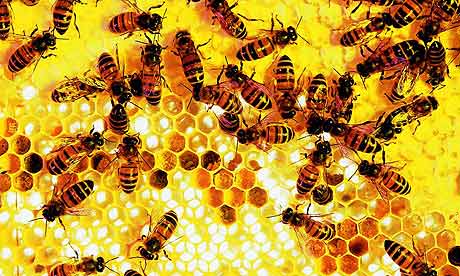
    Honeybees


    Researchers found that bees could solve the 'travelling salesman's' shortest route problem, despite having a brain the size of a grass seed. Photograph: Rex Features

    Bees can solve complex mathematical problems which keep computers busy for days, research has shown.

    The insects learn to fly the shortest route between flowers discovered in random order, effectively solving the "travelling salesman problem" , said scientists at Royal Holloway, University of London.

    The conundrum involves finding the shortest route that allows a travelling salesman to call at all the locations he has to visit. Computers solve the problem by comparing the length of all possible routes and choosing the one that is shortest.

    Bees manage to reach the same solution using a brain the size of a grass seed.

    Dr Nigel Raine, from Royal Holloway's school of biological sciences, said: "Foraging bees solve travelling salesman problems every day. They visit flowers at multiple locations and, because bees use lots of energy to fly, they find a route which keeps flying to a minimum."

    Using computer-controlled artificial flowers to test bee behaviour, his wanted to know whether the insects would follow a simple route defined by the order in which they found the flowers, or look for the shortest route.

    After exploring the location of the flowers, the bees quickly learned to fly the best route for saving time and energy.

    The research, due to appear this week in the journal The American Naturalist, has implications for the human world. Modern living depends on networks such as traffic flows, internet information and business supply chains.

    "Despite their tiny brains bees are capable of extraordinary feats of behaviour," said Raine. "We need to understand how they can solve the travelling salesman problem without a computer."


    Source: http://www.guardian.co.uk/world/2010/oct/24/bees-route-finding-problems

Thursday, September 30, 2010

Autumn Hive Inspection

September 30 - took a trip out to the hive today, as it's been two months since my last inspection. When we got there, the bees were coming and going from the hive in huge numbers. They know fall is here, and winter's going to come roaring around the corner, and there isn't too much time left for foraging. They're all working overtime to provision themselves for the long, cold months they'll spend cooped up inside with nothing to do. Winter must be a nerve-wracking time for them.


Back in July, There had been some comb built on the central frames in the upper super, but very little - it was more of a light coating of wax than proper comb. I had hoped that by now, the lower super would be full of honey and the bees would have started turning their attention to the uppers, where there were eight empty frames waiting to be filled as well, allowing them to double their storage capacity.


Well, I wasn't disappointed. Even before I removed the center upper frame, the thousands of little faces staring up at me was a testimony to the fact that they had indeed been putting in a lot of hours to get the upper super in shape:


And once I got the center upper frame out (burr comb attaching it to the frame below made it difficult again), I was relieved to find that their progress was actually better than I had expected. There was lots of nectar, pollen and capped brood. The queen is present and laying eggs in the upper chamber, and the workers are preparing it for more.


These girls make me proud. This is what I had hoped for. This means that the lower super is full -- or at least full enough that the bees have begun to focus their efforts on the upper frames -- and that the lower super is now considered by the bees to be almost exclusively "storage." The next time I inspect the hive (in about a month), this frame will more than likely be completely full, and the others around it may look like this one does now.

In case you are wondering why I usually emphasize the center frames in my inspection reports, it's because honeybees work upward from below and outward from the center. In a brand new, empty hive, such as this one was back in May, the bees have the entire space to work on. Being such an organized society, they maximize efficiency by concentrating on the bottom of the center frame, building comb upwards, simultaneously on both sides, to cover the frame. When both sides of the center frame have been filled, they start at the bottoms of the frames on either side of the center, and so on outward toward the walls of the wooden super. Once the downstairs is full of honey, they move upstairs and begin all over again with the bottom of the center frame. When I installed this colony into the empty hive, there was only one super (which is now the lower super), but even if there had been two supers, a lower and an upper, the bees still would have begun working from the bottom of the lower frames first. Therefore, I use the center frames as a yardstick to measure their progress. Once I saw that there was nectar, pollen and brood in the center upper frame, I knew that everything is going well and the surrounding frames will receive their attention soon, and that the lower frames are, for all intents and purposes, full of ripening honey.

If there had not been progress on the upper frames by now, it would have been an indication that something was seriously wrong, and I would have placed their chances of surviving the winter at somewhere around 20-25% without supplemental feeding with syrup. There simply would not have been enough honey to feed the colony, and they would starve once the stores were depleted. Now that they have begun filling the cells in the upper super, though, their chances of survival are increasing, and that's an encouraging thought. One of the rules in beekeeping is to allow your bees about 60 lbs. of honey to get them through the winter, and anything over that is yours to steal. A single frame, when full, holds about 6 pounds of honey. Because I'm using 8-frame equipment (8 frames in the lower and 8 frames in the upper super), the lower super alone, when full, can hold about 48 pounds of honey -- and that's assuming that all 8 frames are completely full. Now that my bees have begun filling the upper frames, they just might hit that 60-pound mark before the freeze. They still have a lot of work to do.

Thursday, September 23, 2010

Bee Informed, Part 5: Bees and Alcohol


The psychology department at Oklahoma State University has finally answered a question that has plagued mankind since the dawn of time: What happens when bees get drunk?

Here are the results of the experiment:


BACKGROUND:
The purpose of this experiment was to test the feasibility of creating an animal model of ethanol consumption using social insects. Honey bees were selected as the model social insect because much is known about their natural history, physiology, genetics, and behavior. They are also inexpensive to procure and maintain. Of special interest is their use of communication and social organization.

METHODS: Using both between- and within-experiment designs, studies were conducted with harnessed foragers to determine whether honey bees would consume ethanol mixed with sucrose (and, in some cases, water). Shuttle-box and running-wheel studies were conducted to examine the effect of ethanol on locomotion. The effect of ethanol on stinging behavior in harnessed foragers was investigated. The effect of ethanol on Pavlovian conditioning of proboscis extension was also investigated. Finally, in a self-administration study, foraging honey bees were trained to fly to an artificial flower containing ethanol.

RESULTS: (1) Harnessed honey bees readily consume 1%, 5%, 10%, and 20% ethanol solutions; (2) 95% ethanol will also be consumed as long as the antennae do not make contact with the solution; (3) with the exception of 95% ethanol, consumption as measured by contact time or amount consumed does not differ in animals that consume 1%, 5%, 10%, and 20% ethanol solutions; (4) exposure to a lesser (or greater) concentration of ethanol does not influence consumption of a greater (or lesser) concentration; (5) consumption of 10% and 20% ethanol solutions decreases locomotion when tested in both a shuttle-box and running-wheel situation; (6) consumption of 1%, 5%, 10%, and 20% ethanol does not influence stinging behavior in harnessed foragers; (7) ethanol solutions greater than 5% significantly impair Pavlovian conditioning of proboscis extension; and (8) free-flying honey bee foragers will readily drink from an artificial flower containing 5% ethanol.

CONCLUSIONS: The experiments on consumption, locomotion, and learning suggest that exposure to ethanol influences behavior of honey bees similar to that observed in experiments with analogous vertebrates. The honey bee model presents unique research opportunities regarding the influence of ethanol in the areas of language, social interaction, development, and learning. Although the behavioral results are interesting, similarity between the physiologic effects of ethanol on honey bees and vertebrates has not yet been determined.


Source: http://www.ncbi.nlm.nih.gov/pubmed/10968652


Of course, less scientific studies have been done as well:


(Found on YouTube.)

Thursday, September 2, 2010

Beehavior: The Drones

Among all the frenzied activity in a hive, there are some bees that just don't really do much at all. While the workers are busy cleaning house, foraging for nectar and pollen, guarding the hive, raising young, controlling temperature, collecting water, building comb and attending to the queen, the drones, the males in the colony, live in luxury, without a care in the world. They benefit from their sisters' tireless industry and contribute nothing to the colony on which their survival depends. They eat all they want, sleep when and where they want, and bully the smaller workers. Since a stinger is a modified ovipositor, honeybee drones are stingless, so they can defend neither themselves nor the honey they jealously love and which they did nothing to produce. It's a wonder that their presence is tolerated (though perhaps grudgingly) in such a goal-oriented society at all.


Drones are expected to do only one job in their lives: to mate with a virgin queen. When not availing themselves of the colony's stored food, they spend their lives lazily hanging out with the boys away from the hive in places called drone congregation areas. There they spend hours each day playing poker and shooting pool, and talking about how their women are always nagging them to take out the garbage (or the bee equivalent) as they wait for a queen to fly by. Yes, they've got it tough, those drones.
It's still unknown how drone congregation areas are designated, but they are agreed-upon locations that are known by both the drones and the queens from all the hives in the general vicinity. Because a queen's nuptial flight is fraught with danger, and she risks her life by leaving the safety of the hive to mate (usually only once in her life), it makes sense that there should be a specific place for her to go in order to mate quickly and return to the hive. Congregation areas are also convenient for providing a genetic variety and preventing inbreeding. These areas are usually found in the same place year after year, which raises some interesting questions. How do the drones, who have never been to the congregation area before, know where it is? For that matter, how do the queens know where to find them? What are the criteria for an acceptable location for a congregation? Geographical features such as hills and valleys or water sources? And for that matter, what if the criteria are not met some year? Is there an alternative system for designating one? For now, these are among the secrets that the bees see fit to keep from us.

When the weather is good and a virgin queen takes off from her hive on her nuptial flight, she will fly to a local drone congregation area, exuding pheromones and flashing her best come-hither looks. The drones will fly after her and chase her down, mating with her while in flight. The mating itself takes place at relatively high altitude, out of sight of observers on the ground, and so is rarely witnessed by beekeepers. Unlike many other species, there is no competition between drones for the opportunity to mate with the queen - no battles to the death or chasing each other off, with the victor earning the right to mate. There are two main reasons for this: firstly, since drones don't have stingers, they lack the necessary evolutionary weapons for such battles, and secondly, because the queen flies through the area and does not stop, any drones who engaged in such contests would simply find the queen gone after taking the time to vanquish their rivals. So the drones who can fly fast enough to catch up to the queen get to mate with her, thus achieving their purpose in life. But here's where cruel irony steps in: the act of mating itself is fatal to the drones. Upon the release of sperm, the drone's reproductive organ (the endophallus) tears off, along with part of his abdomen, and remains attached to the queen, forming a plug that prevents the loss of sperm after copulation. (This is known as eversion, and it's said that there is actually an audible pop when the endophallus breaks off.) The mortally-wounded drone then falls to the ground and dies soon after. This plug also provides visible evidence of her successful mating flight, to be removed by the workers, when she returns to the hive.


Maybe it's because of this agonizing sexual suicide that the workers in a colony tolerate the presence of the boorish drones who treat them so cavalierly. It's possible that the girls feel some measure of pity for them. If that is the case, though, that pity and tolerance doesn't last. When the weather becomes colder and the colony prepares for winter, the workers turn on their brothers and physically eject them from the hive. Since mating season is over and the drones have big appetites, they are forced out in order to conserve the winter stores. Some drones will attempt to re-enter the hive and are killed. Others are resigned to their fate and remain close to the entrance, where they succumb to the cold or to starvation. It's tragic, in a way: these are the drones that were not fast enough fliers to earn the right to mate with a queen and die, and it almost seems to be a punishment for their physical shortcomings and inability to pass on their genes. If their life's purpose is not served during the warm season, then their contract with the colony, their own family, is voided and they are replaced in the spring.

Here's one last bit of information about drones that I find worth mentioning. Because the female workers are produced from fertilized (diploid) eggs and the male drones from unfertilized (haploid) eggs, honeybee drones do not have fathers. Their nearest male relative is a grandfather on their mother's side. Interesting stuff, no?

See you again soon. Maybe you should give your brother a call. Or better yet, why not send him a t-shirt?

.

Saturday, August 21, 2010

It's National Honeybee Day!

That's right, folks. More specifically, National Honeybee Awareness Day -- the most important holiday of the year.
For beekeepers.

Anyway, I'll bet you didn't even know there was a national holiday for bees. For shame. Do you think mothers and Valentines are more important than our pollinating friends? Well, do ya? Punk?

If you haven't heard about it, that could be because the first National Honeybee Awareness Day was only last year. It was formally recognized by the Secretary of Agriculture in August of 2009 and is a day promoted to the advancement of beekeeping and the awareness of environmental concerns in general. Good stuff.

Want to know more? Here's the official National Honeybee Awareness Day website.

Now get out there and hug a bee.

Thursday, July 29, 2010

Second-Story Inspection, or "What Dem Bees Up To?"

It's been over a month, so it was time to brave the hot, hot Kansas summer and check on the girls again. And I was happy to get back in the field.


I had added a second super in June, and I wanted to see some progress on it.
It was not to be. Some of the more forward-thinking bees have begun to build some comb on the upper frames, but not much. Downstairs is still where the action is.


Instead, the bees were more intent on sealing the frames together by adding burr comb as a bridge between the upper and lower frames. Burr comb is, from the point of view of the ever-efficient bees, a remedy for the otherwise empty, usable space between the top and bottom supers. From the point of view of the beekeeper, it's just a nuisance. Because of the natural strength of dried and hardened wax, burr comb makes it difficult to slide an upper frame out when it's been glued to the frame beneath it. To put the strength of wax in perspective, I estimate that the center lower frame, where most of the brood and honey is being stored, currently weighs about six to eight pounds. When I tried to remove the center upper frame directly above it (which was empty of brood and honey and therefore weighed only a few ounces), the burr comb attaching the two frames caused the lower frame to pull out along with it. A thin strip of burr comb, only about half an inch thick, was able to lift eight pounds without breaking. And so begins an eternal dance between bee and beekeeper: they will continue to build burr comb and I will have to continue to cut it away. But I'm adding to my wax collection with each inspection. Perhaps I'll have a future as a chandler. I've made one ugly, lumpy, sad-looking little candle with my bees' wax so far, and while not much to look at, it did burn beautifully - and it smelled nice too.


Another delightful substance produced by bees, and also used for sealing cracks and spaces in the hive, is propolis, which is often affectionately referred to as "bee glue." Propolis is a viscous paste collected from tree buds, and is another of beekeeping's pleasant little annoyances. When soft, propolis is gooey, yellow and very sticky. If it gets on fibers such as clothes, it's there forever. When it hardens, propolis is similar to cement and becomes notoriously difficult to remove. My bees have decided to begin the process of sealing the inner cover to the upper super with propolis. From here on out, much of my inspections will be spent scraping at propolis and burr comb.


I had hoped to be able to collect some honey from my bees in the fall, but it looks like that's not going to be possible this year. Because the hive was brand new and was started so late in the season, the bees have had to work hard to get where they are now. They've got a very nice colony going, but the honey they collect is going to have to last them through the winter. There won't be any surplus for me to steal from them. The foraging season will only be a couple of months longer. Next year will be a different story, though. As long as the colony survives this winter on what they have, they will get a good head start on the spring, and there will be more honey than they, or I, could possibly ever use. And won't that be sweet?

See you next time.

Friday, June 25, 2010

Ummm... Never Mind?

So, yeah.
I have some good news, and some weird news:

The good news is that when I returned to the hive yesterday, I found a queen! Hooray!

The weird news? Well, it's the original queen. Oh... Kaaaay...

I was checking to see if the queen cells that I found last week were empty, and in doing so, she made her appearance as though nothing had happened. "Oh, hey, Jay. How's things? Just laying some eggs, you know. What's new?" Didn't she know that I had been worried sick?

So I may have been a bit hasty in my previous determination that she had died. I swear that I checked every bit of comb for her, and she wasn't there. I swear. It's possible that she was out of view on the bottom board, though that would have been unusual. Did she leave the hive and return? Also unusual. Either I have a crazy queen, or possibly, just possibly, I'm new at this.
I vote crazy queen.


Needless to say, I was both relieved and confused. If there had been a queen all along, why did the workers decide to construct emergency queen-rearing cells? Upon closer investigation, it seems likely that the queen cells may have actually been clusters of drone cells, stacked very close together. Because drones are larger than workers, cells containing drone brood are larger than those containing worker brood, and appear as lumps among the otherwise flat landscape of capped comb containing pupal workers. Queen cells are likewise larger than drone cells.
One of my two tentative theories is that my queen had planted drone eggs in three or four adjacent cells, and, once capped by the workers, they appeared to my novice eyes as one large capped cell, which, judging by its size, could only house a queen. This, compounded with the fact that I couldn't find the queen, led me to the conclusion that my queen had died and the workers were taking steps to replace her. If these were actually drone cells, I won't be making that mistake again.

However, there is another possibility, though more remote. The queen may have actually left the hive to mate a second time. This happens if her first mating flight was not as successful as she would have liked. Usually, queens will take only one nuptial flight, mating with several drones in succession, and returning to the hive with her spermatheca full. The spermatheca is the organ in which the queen stores sperm, releasing it to fertilize only those eggs that will produce workers. Unfertilized eggs produce drones, and the queen decides which eggs will be fertilized and which won't. She knows what she's doing. A full spermatheca from a single mating flight can last a lifetime of egg-laying, up to 5 years.
But if the amount of sperm stored in her spermatheca from her first nuptial flight was running low due to a small number of drones encountered, she may have taken a second flight to replenish it. This occurrence is uncommon, but it can happen, especially if the queen has been artificially inseminated by the apiary in which she was raised. (Yes, bees can be artificially inseminated, and it's done to ensure that the apiary is selling "mated" queens.)
If she did leave the hive to mate again, the workers, having discovered her absence, would have immediately begun to prepare her successor in the event that she didn't return. So I may have correctly identified queen cells after all. Upon her return, having successfully mated, the queen would have torn open the new queen cells and killed the young queens inside. During this latest inspection, I noticed that the "queen cells" that I saw last time were still capped, but much smaller. This could indicate that they were indeed queen cells, and that the queen returned and dispatched the pretenders within, and the workers then patched the comb where the queen had damaged it.

The first theory is probably more likely, but the second is not outside the realm of probability. I can't be certain what actually happened, but either way, it really doesn't matter.

So, all in all, a good visit. My queen, "Steve," is still present and doing her job.*
I also noted that many of the capped cells that I saw last week are now empty, meaning that the young bees within have since emerged. The colony's population is increasing.
Having removed the entrance reducer, the guard bees are now visible, and the foragers are coming and going much more freely. (The entrance reducer is a wooden dowel with a 1-inch space cut out of it, blocking most of the entrance and making it easier for small colonies to guard. Now that their numbers are growing, I decided that it was time to allow them unrestricted access to and from the hive, which will improve the foragers' productivity. The entrance reducer can clearly be seen in pictures from previous posts.)
The second brood chamber that I added to the top of the hive is mostly empty, though some workers have begun building wax on the frames within. The vast majority are still concentrating on the frames in the lower super, which is still not full.


My inspection visits will now be less frequent. I'm going to let my girls do their thing undisturbed for a while. My next visit will probably be in mid-July. By that time, I expect to see many more bees, comb drawn out in the upper super, much more pollen and brood, and lots of capped honey. I'll still keep a-bloggin', though, so don't change that channel.


* Steve theQueen! Get it?

Wednesday, June 16, 2010

The Queen is Dead. Long Live the Queen!


June 16, 2010: Ginny and I took a trip out to the hive today, and we made some interesting discoveries.

Firstly, the top feeder was empty, so it could finally be removed, forcing the bees to now forage for all their food. They had already been doing so, as indicated by the amount of pollen stored in the hive, but it's time to get this colony motivated. No more free rides.
Also, as I had predicted last week, there was comb built on 70% of the frames, so I added a second super with eight new frames on top of the first. The colony now has twice as much growing room, and will surely be glad about that.

Last week, I was unable to find any eggs. I had hoped that this week's inspection would reveal some new brood, and I was not disappointed in that regard. After six days, the larvae spin a cocoon around themselves and begin their pupal stage. At this time, their caretakers will build a wax cap over the cells containing the pupae, which will chew their way out through these caps twelve days later as mature adults. There was a good amount of capped brood cells, and their presence was an encouraging sight. I was also able to see some larvae as well, but not as many as I had hoped...

...and I couldn't find the queen.

This was not as encouraging. A productive, egg-laying queen is essential for the survival of the colony. Without her, this generation would be the last, and as the adults die off, the colony will not be able to support itself and there would be little hope for its future.

After removing each frame in turn, and with no queen in sight, I began to despair. My first hive, it seemed, would be a failure. I would watch my bees decrease in numbers over the next couple of months, until finally there would be a pitiful few left in the hive, exposing it to infestation from pests, such as mice and wax moths. A grim prospect indeed, and another setback for my colony, which has already suffered through the stresses of shipping and a late hiving.

However, while I was searching for the queen, I noticed something else: a small, peanut-shaped lump protruding from the comb on the center frame -- a queen cell. When a queen dies, the others in the colony usually notice her absence quickly (within 24 hours), and a general state of emergency is declared. In such circumstances, the workers will designate a new queen from among the larvae already present in the comb, and that's what exactly they did. One of their sisters will soon become their new queen, and she will likely emerge within the next week.

One question remains, however. How did the queen die? Did she succumb to disease or parasites? It's possible. Was she assassinated by the colony? There's a chance. Did I accidentally crush her in my fumbling as a novice beekeeper? Though I hate to admit the possibility, it can't be discounted. Or did she simply abandon the hive? Unlikely, but not unheard of. The answer, unfortunately, will remain a mystery, but I take no small amount of comfort in the fact that the bees know what to do. I'm learning from them with every visit to the hive.

While reviewing the pictures that Ginny took, I noticed that there are, in fact, at least two queen cells, not just one. The workers are hedging their bets. There are a couple of ways this drama can unfold, depending on how close the two (or more) potential new queens are in age. If one emerges first, she will announce her presence to the colony with a loud "piping" sound, which is also a battle cry, challenging her rivals. The other, immature queen(s) still in her cell will "quack" in reply, before she is stung to death within the cell. If they emerge from their cells simultaneously, however, this vocal argument will be followed by a fight to the death, with the survivor becoming the colony's new mother. She will be accepted by the rest of the colony unconditionally, by virtue of her victory, and because she is one of their own. She was elected to the position by her sisters, and raised especially for that purpose.

(Want to hear what that sounds like? Here's a recording of queens vocalizing to each other):


The first sound is a queen "piping" a challenge, and it is answered by another's "quacking."

In either case, the new virgin queen will take her nuptial flight as early as a week after her emergence, mating with up to 15 drones before returning to the hive. Afterward, she will continuously lay eggs for the remainder of her lifetime, picking up where the former queen left off.

I'm looking forward to further inspections. I'm hopeful that my next visit will show evidence of a new queen -- and with good timing and some luck, perhaps we can even record her emergence. Check back soon for updates.